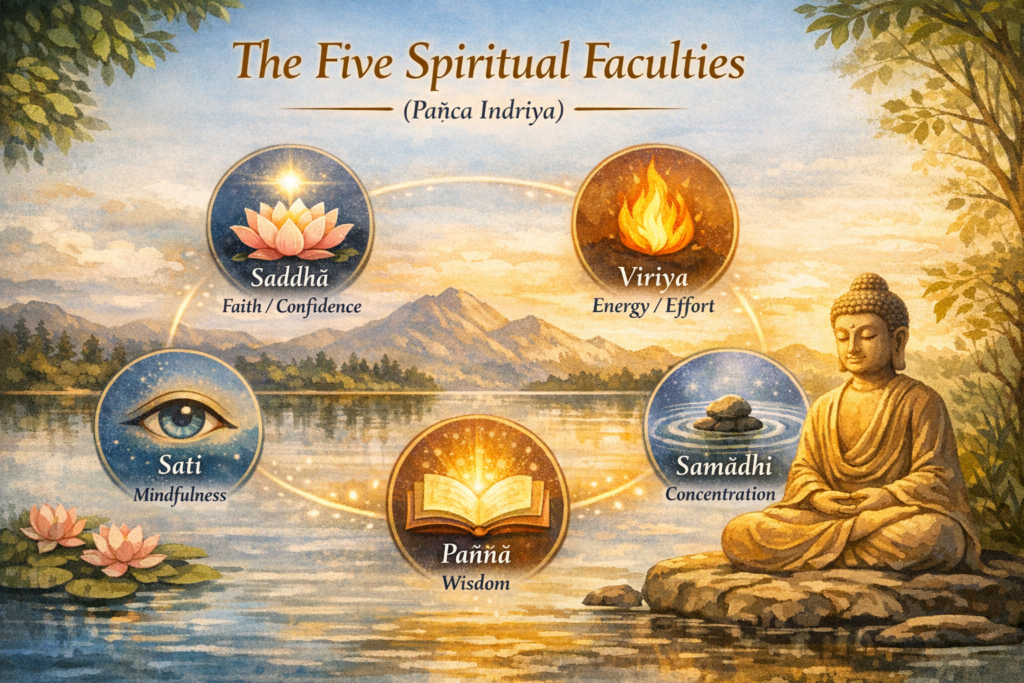
Finding Inner Balance: The Five Mental Qualities That Transform the Mind
Buddhist psychology, particularly in the Theravāda tradition, offers something rare: a practical map of the mind. Not mystical speculation, but a clear framework for how ordinary people can work with their inner lives. At the heart of this map are five mental qualities known as the Five Spiritual Faculties.
Think of them as inner muscles. Develop them together, keep them in balance, and something remarkable happens — the mind becomes clearer, steadier, and freer.
The five are: Faith, Energy, Mindfulness, Concentration, and Wisdom.
Faith — But Not the Blind Kind
When most people hear “faith,” they picture unquestioning belief. Buddhist faith is different. It’s more like confidence — the kind that comes from actually trying something and seeing it work.
The Buddha famously told a group of villagers in the Kālāma Sutta not to believe something just because a teacher says so, or because it’s written in a sacred text. Test it. See for yourself. Faith, in this sense, is what gets you to try in the first place. It’s the hopeful curiosity that says, maybe change is possible.
Left unchecked, though, faith tips into superstition. That’s where wisdom comes in.
Energy — The Middle Path of Effort
You can’t half-heartedly practice anything and expect results. Energy — the willingness to show up, to try, to keep going — is essential.
But the Buddha was careful here. He once compared the mind to a lute string: too tight and it snaps, too loose and it won’t play. Push too hard in meditation or in life and you get anxious and restless. Let yourself go slack and you drift into laziness and fog.
Sustainable effort is the goal. Consistent, grounded, not frantic.
Mindfulness — The One That Holds Everything Together
Of the five, mindfulness plays a unique role. It’s less about producing something and more about watching — noticing what’s actually happening in your mind without immediately reacting to it.
Feeling angry? Mindfulness sees the anger without being swept away by it. Feeling confident? Mindfulness notices when that confidence is tipping into arrogance.
In this framework, mindfulness keeps the other four qualities honest. It catches faith becoming gullibility, wisdom becoming cold cynicism, energy becoming aggression, and concentration becoming dull detachment.
It’s the balancing faculty. The inner referee.
Concentration — A Still Lake
The Buddha often described a concentrated mind as a still, clear lake. When the water is turbulent, you can’t see the bottom. When it settles, everything becomes visible.
Concentration doesn’t mean forcing the mind to go blank. It means training the mind to rest on one thing without constantly darting away. This kind of stillness isn’t passive — it’s a platform. A steady mind can see things a scattered mind simply cannot.
Wisdom — Seeing Things As They Actually Are
This is where everything comes together. Wisdom, in this tradition, isn’t book knowledge or clever thinking. It’s direct seeing — watching your own experience closely enough to notice that everything changes, that clinging causes suffering, and that what you call “yourself” is really just a flowing collection of experiences and reactions.
That sounds abstract. In practice, it’s very concrete. You watch anger rise and fade. You notice a mood color your entire interpretation of a situation. You catch yourself identifying with a thought as if it were you, then watch it dissolve. Over time, this kind of seeing loosens the grip that habitual patterns have on you.
Wisdom also keeps faith grounded. It prevents devotion from becoming delusion.
Why Balance Matters
These five don’t operate in isolation. They work in pairs:
- Faith and Wisdom check each other. Faith without wisdom is blind. Wisdom without faith is cold and goes nowhere.
- Energy and Concentration balance each other. Too much drive makes the mind restless. Too much stillness makes it sluggish.
- Mindfulness sits in the middle, keeping watch over all of it.
When all five are working together and kept in balance, something shifts. What were once fragile qualities become stable, unshakable ones — what the tradition calls the Five Powers. Doubt loses its grip. Laziness loses its pull.
This Is Actually About You
What’s striking about this framework is how recognizable it is outside of any religious context. These five qualities show up everywhere human beings are trying to change.
Hope that change is possible. Commitment to doing the work. The ability to pause and notice what you’re feeling. Mental stability under pressure. The insight to understand your own patterns.
That’s the same map, whether you encounter it in a meditation hall, a therapy room, or anywhere people are seriously trying to grow.
The Buddha’s point was simple: develop these qualities together, keep them balanced, and the mind naturally moves toward freedom. Not as a miracle — but as the ordinary result of clear, consistent, human effort.